Samed YILDIRIM
Reading time: 8 minutes
PostgreSQL is the World’s most advanced Open Source Relational Database. The interview series “PostgreSQL Person of the Week” presents the people who make the project what it is today. Read all interviews here.
Please tell us about yourself, and where you are from.
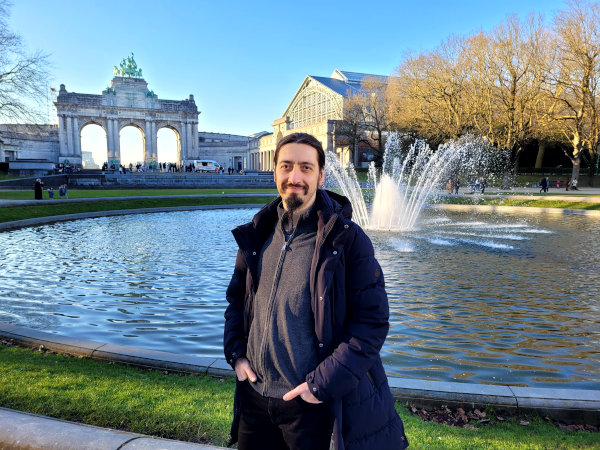
I’m originally from Turkey. The last city I lived in Turkey was Istanbul. I am now living in Riga, Latvia for more than 5 years already.
How do you spend your free time? What are your hobbies?
I’m one of the lucky people who converted their hobbies into their work. In other words, working with computers is my hobby. I spend the most of my free time working on fun personal projects related to technology.
In addition to that I love travelling, walking, finance, and enjoy drinking coffee. I’m a very good customer of multiple coffee shops in Riga. If I don’t have any special plan for my free time, I go for a walk, grab a coffee, sit in a coffee shop, and watch people coming in and out while cleaning my mind for the next fun project. 🙂
I also participate in PostgreSQL related events all around Europe as much as possible. It helps me to combine my multiple hobbies and enjoy my time even more.
Any exercises you do regularly?
If walking counts, I do. I like walking for one or two hours every day if the weather allows me.
Any Social Media channels of yours we should be aware of?
I’m not a social media person. I use only LinkedIn, not very actively though.
Last book you read? Or a book you want to recommend to readers?
This question hurts. I realised I couldn’t read any book in my wishlist in the last 4 months. The last two books I read were „Never Split the Difference“ by Christopher Voss and „The Unfair Advantage by“ Ash Ali.
I’d like to recommend two books to readers: „Outsiders“ by Howard S. Becker and „The Trial“ by Franz Kafka.
I always find things that people inherently accept without questioning hard to accept. It sometimes makes me feel like an outsider. What is right, what is wrong, who gets to decide that… „Outsiders“ is a key work on the sociology of deviance. It explains that deviance is not about the act itself, but how society and rule-makers define and respond to it. Depending on these definitions, individuals can be labeled as “outsiders”. It perfectly resonated with me and the feeling of being an outsider.
Kafka’s book tells the story of a man who is tried for an unknown crime. It highlights the sense of alienation when one has to deal with a rigid and bureaucratic system. The first time I read this book I was experiencing a mild panic-attack and elevated anxiety. And, it happened to be the closest book within my reach. It immediately pulled me into its philosophical anxiety-filled world. Since that moment, it has held a special place for me.
If I had to say something about both books shortly, it would be that they explore how individuals are affected by larger systems from a different angle. They are both very thought-provoking and made me look at societies and rules from a different perspective.
Favorite movie, or show?
There are a lot of series that I watched multiple times: The Good Place, Rick and Morty, Santa Clarita Diet … They are old, but I have two favourite movies: 12 Angry Men and The Man from Earth
Best music, best song?
I’m a fan of Şebnem Ferah, the queen of Turkish Rock.
Are you a gamer?
No. I don’t play games often. The only game I play sometimes is Counter Strike.
Best food?
Best food, a single answer… It is impossible for me. I love eating. I love eating everything delicious. I cannot narrow it down to a single one.
Best drink? Non-alcoholic or alcoholic?
I generally prefer non-alcoholic beverages. I love coffee. I drink it all day long.
What does your ideal weekend look like?
It would be going to a not very crowded park with coffee, some snacks, and a book alone on a sunny day. I would sit on grass, read the book, and watch around. It helps me to clear my mind and gives me a good rest.
What’s still on your bucket list?
I have an infinitely long idea/personal project list. On the top of my list is learning Latvian. I have been living here for many years. But, I still cannot speak Latvian well.
When did you start using PostgreSQL, and why?
As far as I remember, it was in 2011 and PostgreSQL 9.0. I was working part-time at the university in the IT department. At the same time, I was a freelance developer. One of my customers had a relatively big MySQL database and was experiencing performance issues. It was the first time I tried PostgreSQL. I migrated the database to PostgreSQL for testing. It was the first time I touched PostgreSQL with very limited knowledge. And, the results were incredible. Then, my focus moved towards PostgreSQL.
Do you remember which version of PostgreSQL you started with?
I guess it was PostgreSQL 9.0.
Have you studied at a university? If yes, was it related to computers? Did your study help you with your current job?
Yes. I’m actually an electrical engineer. After my bachelor degree, I started my master’s degree in computer engineering the next semester at the same university, Istanbul Technical University. However, it was a really demanding programme. I spent 4 years there. After 4 years along with full-time work, I couldn’t take it anymore and quitted.
3 years ago, I decided to start over. After spending another 2.5 years, I managed to complete the master degree a couple months ago. My study helped me indirectly. My programme, my professors, and the university taught me how to research, think outside the box, be creative, and not to give up. The culture of the university was the one that helped me in my work and life. It is invaluable.
What other databases are you using? Which one is your favorite?
My main focus is PostgreSQL. In addition to it, I rarely use MySQL and SQLite. My favourite by far is Postgres.
How do you contribute to PostgreSQL?
So far, I haven’t contributed to PostgreSQL core directly.
- I participate in PostgreSQL events. My contribution is mostly with my presence.
- I used to write blogs and give PostgreSQL training.
- I try to follow and answer questions in PostgreSQL mailing lists.
- I have an open source PostgreSQL extension for replicating DDL changes through logical replication.
- I also worked on the PostgreSQL’s planner and implemented the ant colony optimization many years ago.
- I recently started volunteering in the community. It is still very limited though.
What is your favorite PostgreSQL extension?
pg_trgm is my favourite. In addition to that, I also love foreign data wrappers in general. It is really helpful to interact with other databases and services directly via FDW.
What is the most annoying PostgreSQL thing you can think of? And any chance to fix it?
The most troublesome thing was stopping logical replication when schema changes on the publisher side. I experienced countless instances where logical replication stopped and WALs were accumulated on the publisher side because someone silently added a column to a table. I was so frustrated with that. I ended up with creating an extension replicating schema changes over logical replication (PGXN).
What is the feature you like most in the latest PostgreSQL version?
Failover for logical replication slots and migrating logical replication slots with pg_upgrade.
Adding to that, what feature/mechanism would you like to see in PostgreSQL? And why?
Live minor version update functionality would be awesome. Even though it takes less than a minute, it is a downtime.
Should PostgreSQL have a built-in connection pooler?
It would be nice. It can decrease establishing a new connection even further. But, almost all modern languages have internal connection pooling functionality. That’s why I would spend the effort and the budget on something else instead of a built-in connection pooler.
Should PostgreSQL have built-in multi-master replication?
I’m still not convinced enough to support multi-master replication for PostgreSQL. So, my answer is still no.
Which PostgreSQL conferences do you visit? Do you submit talks?
I try to visit all PostgreSQL conferences and PgDay around Europe as a participant. However, I have never submitted a talk, yet.
Do you think PostgreSQL has a high entry barrier?
I don’t think there is such a barrier anymore. There are virtually unlimited amounts of resources available in all forms, youtube videos, online training, documents, mailing lists, and AI of course.
Do you think PostgreSQL will be here for many years in the future?
I truly believe that Postgres will have a long life in multiple ways. It is a very feature rich and extensible database. Instead of adding new features or maintaining them inside of the core, I see PostgreSQL’s future as a core database platform. And, it is already like this at some level. In my future projection, PostgreSQL’s core, which will probably be a fork, will be much simpler and smaller with much limited functionalities. And, we will add the features we want, which is what we do with extensions already. 🙂
Would you recommend PostgreSQL for business, or for side projects?
In terms of seriousness, there is no difference between side projects and business projects for me. That’s why I recommend PostgreSQL for both.
What is your opinion on ORMs?
“Can’t live with them, can’t live without them.”
This idiom explains my feelings about ORMs. It provides a low entry barrier for developers who need to interact with databases in a database agnostic way. It is very good for simpler cases and using them is a good business decision. When a customer wants to migrate from a proprietary DBMS to PostgreSQL, ORMs, especially exclusively using only ORMs, make my and their life so easy. Whenever complex tasks, reports, bigger database sizes etc are involved into the picture, ORMs reveal their dark side. 🙂
SQL versus NoSQL databases?
It depends. I cannot call myself a NoSQL advocate. But, they are good in some certain scenarios.
Share: