Ayse Bilge Ince
Reading time: 9 minutes
PostgreSQL is the World’s most advanced Open Source Relational Database. The interview series “PostgreSQL Person of the Week” presents the people who make the project what it is today. Read all interviews here.
Please tell us about yourself, and where you are from.
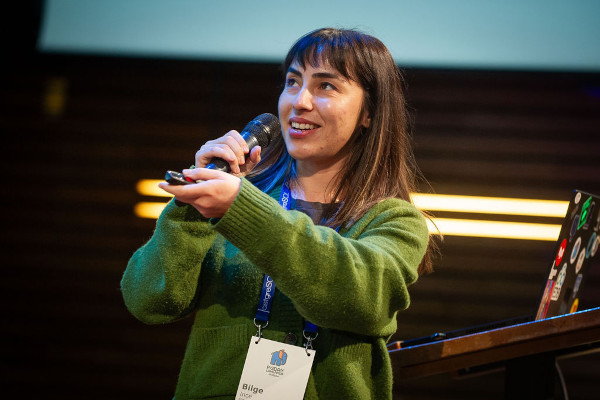
Hello! I’m Bilge Ince. Originally from Turkey, I now call London home. I’m currently a Machine Learning Engineer at EDB, which is also how I began connecting with the PostgreSQL community. But my journey in the world of Artificial Intelligence goes back to 13 years ago till my bachelor degree. Moreover, I co-organize the Diva:Dive Into AI conference and I host my own podcast in Turkish. In my podcast, I interview Turkish professionals from the IT field, discuss their work, company culture, daily lives, and more—similar to this format, but in audio.
How do you spend your free time? What are your hobbies?
I have a strong passion for Muay Thai and running, frequently training for upcoming marathons and half marathons. In my free time, I enjoy reading and consider myself a dedicated reader, often getting lost in fiction.
Any Social Media channels of yours we should be aware of?
I have a Medium account though I should admit, I don’t blog as much as I desire anymore. Also I have a bluesky account which I don’t use it very actively.
Last book you read? Or a book you want to recommend to readers?
This is a topic I can’t shut up about, sorry there is no single book. Last book I read was the Stepford Wives and I highly recommend it for those who need a short but intense read. However, the book I want to recommend to every single person is from Carolina C. Perez - Invisible Women: Exposing Data Bias in a World Designed for Men. After this book, I learnt that even the way we’re having heart attacks is different and what we’ve taught as a sign of heart attack is for men not for women. This book is great for awareness about how our world has been designed for an average man (1.7m).
Favorite movie, or show?
While I wouldn’t classify myself as a passionate movie aficionado, I have a deep fondness for two particular series: The Lord of the Rings and Harry Potter. Both movies and books together are my favorites.
Best music, best song?
I’ve been passionate about metal music since I was young, so “Welcome to the Jungle” by Guns N’ Roses, “Ghost Love Score” from Nightwish (specifically the Floor Jansen version), and “Sabba Cadabra” by Metallica are some of my top picks.
Best food?
I believe I have several favorites since I love food and eating in general. To start, I enjoy Baklava with pistachios from Gaziantep, Turkey, although I’m not generally a big fan of Baklava. Other top choices of mine include Portuguese tarts (also known as Pastel de Nata), Manti (Turkish dumplings), Tantuni (again from Turkish cuisine), Chicken Biryani, and Feijoada.
Best drink? Non-alcoholic or alcoholic?
Caipirinha is my absolute favorite for alcoholic drinks and Kombucha for non-alcoholic drinks.
What does your ideal weekend look like?
Enjoying Saturday with friends, preferably in a quaint village a short train ride from London. On Sunday, beginning with an early morning long run, then indulging in a relaxing Turkish-style breakfast (or brunch), and wrapping up the day with some quiet time to read and relax.
What’s still on your bucket list?
Bungee-jumping and going to the Wacken Metal Festival. Both were my childhood dreams and they’re still in my bucket list.
What is the best advice you ever got?
This combines two of the best pieces of advice I’ve ever received, which I believe complement each other perfectly: “Be creative and pay attention to the details in everything you do, seeing the world through an artist’s eyes. But don’t be a perfectionist.”
When did you start using PostgreSQL, and why?
I began using PostgreSQL during my undergraduate studies mainly because it was a free resource. I always considered it a bit challenging to grasp compared to other relational SQL databases with no obvious reason. Then I didn’t use it much for a while. That was my experience until I joined EDB, which has really helped me deepen my understanding of PostgreSQL. Before that, I was mostly focused on AI applications and model training, so PostgreSQL didn’t really become my primary choice at the time.
Do you remember which version of PostgreSQL you started with?
I don’t remember the first one. Therefore I’ll go with version 16, it’s the version I started using seriously.
Have you studied at a university? If yes, was it related to computers? Did your study help you with your current job?
Yes, in fact multiple universities. One of my dreams as a kid was being an academician and I’ve made it true at a degree. I worked as a research assistant and teaching assistant at Yildiz Technical University in Turkey during my masters and PhD. From the beginning, I did my bachelor degree in Computer Science and I had fallen in love with computer science after I got into university. I loved it so much that I finished university 1 year early. And part of my thesis was to build a text-to-speech app. The approach was super simple as in concatenate the sound pieces together and apply a little signal processing. Then I started my Master’s degree again in computer science and it was mainly about Fraud Detection. Back then I was very much into cyber security problems. After that, I started my PhD in computer science and my PhD thesis was “Mobile Malware Detection and Generation using GANs”. When half of my PhD was finished, Covid arrived, and the world went into chaos. At one point, I had to freeze my PhD and then quit all over. But these whole studying eras of mine have given me a strong background for AI and as a result it immensely helped with my current job.
What other databases are you using? Which one is your favorite?
The other databases I used were Snowflake and MSSQL. I don’t think I had any favorites till I met with PostgreSQL. To me, they were all databases and whichever I needed, I should use it. But then I met with PostgreSQL and later Thomas Munro at PGConf EU. When I asked him why PostgreSQL is so special to him, he answered “because it’s democratizing the data field, even a tribe from Africa can use it”. This answer hit me and I felt attached to PostgreSQL.
On which PostgreSQL-related projects are you currently working?
I’m still actively working on the aidb extension that is bringing AI capabilities into PostgreSQL. Other than that, there are some RAG and insight extraction projects I’m working on. My area is all about data and AI, hence I’m naturally binded to PostgreSQL.
How do you contribute to PostgreSQL?
My contribution to PostgreSQL is not heavily involved by writing code. The aidb extension is my only contribution with code into PostgreSQL. Besides that, I focus on promoting PostgreSQL by speaking at different conferences and meetups. I’ve given talks at events like PGDay Lowlands both Meetup and the conference, and PGConf Europe 2024. I also had a workshop with Boriss Mejias at PGConf Europe 2024.
What is your favorite PostgreSQL extension?
My two favorite extensions are pgvector and aidb, as I actively use them in my development projects.
What is the most annoying PostgreSQL thing you can think of? And any chance to fix it?
I’ve noticed that installing PL/Python and pgvector can be quite challenging and frustrating for Mac users. It would be great if the process were simplified, particularly for those who aren’t already familiar with the PostgreSQL ecosystem. As someone in the AI field, I’m familiar with several extensions such as pg_vectorize, pgai, aidb, and pgml, which I discovered while searching for AI-related PostgreSQL tools. However, I am certain there are numerous other extensions that I have yet to discover. Yet, finding them aren’t easy. I wish there were a specific webpage for PostgreSQL extensions organized by categories.
Which skills are a must have for a PostgreSQL developer/user?
I think the must have skill is reading the documentation. Because I believe almost every feature is well documented in this ecosystem.
Do you use any git best practices, which makes working with PostgreSQL easier?
I don’t think these practices necessarily make working with PostgreSQL easier, but they certainly make working easier for me. My favorites are as follows: git rebase -i to play, clear etc. of the commits in my branch history, git checkout -b to create and switch to a new branch, and git cherry-pick to apply a specific commit to the current branch.
Which PostgreSQL conferences do you visit? Do you submit talks?
I’m still new in this community but PGDay Lowlands Amsterdam is the first one I submitted a talk to, then I ended up talking at the Meetup and delivering a lightning talk at the conference. After that, the latest one was PGConf.EU Athens. I had a workshop and presented a sponsor talk.
Do you think PostgreSQL has a high entry barrier?
My answer to this question is both yes and no. While getting started with PostgreSQL is straightforward, the complexity increases significantly when you go beyond the basics. Engaging with the PostgreSQL community, however, comes with a higher entry barrier—at least, that has been my experience. The community is composed of passionate, dedicated individuals who maintain high standards and have often collaborated for years. As a newcomer, I found it challenging to navigate and establish myself within such a close-knit group, initially. Then I asked for help and the help has been given by none other than Boris Mejias.
Do you think PostgreSQL will be here for many years in the future?
I wholeheartedly believe in this since the PostgreSQL community has many dedicated and passionate people contributing from every angle.
SQL versus NoSQL databases?
I’m not opposed to either SQL or NoSQL; I believe the choice should be driven by specific needs. If your requirements don’t demand relational database capabilities, NoSQL can be a great option. However, if you need relational capabilities or advanced features like vector support, PostgreSQL is an excellent choice.
Anything else you like to add?
I’d like to take this opportunity to express my gratitude to those who helped me become part of the community, particularly Gulcin Yildirim Jelinek, Devrim Gunduz, and Boriss Mejias. Their support has been truly invaluable.
Share: